|
LADY BE GOOD focuses on women who
played jazz during decades when to be a woman in jazz was to be
truly an exception. The homebound status of women was enhanced by
women learning to play the piano. Emerging from these homes were
excellent women musicians who joined minstrel bands and Ladies Orchestras
in the late 1800s. From this beginning and into the twentieth
century, these women moved to the all-women jazz bands, mostly male
jazz bands, the women units of the thirties, to the big bands and
swing units of the forties and to the combos of the fifties. These
chapters of the ongoing story of women in jazz show that many were
discouraged by prejudice and an unreceptive culture. Their presence,
often against formidable odds, constituted a rebuttal to the argument
that women cannot and should not play most instruments. These women
are a part of history as pioneers and role models.
This is clearly an important story and
chapter in American musical history, which is perfectly suited to
the documentary format and is a story, which has yet to be told.
In addition to telling powerful stories, LADY BE GOOD will
educate people about the importance of female musicianship and their
persistence in the male-dominated jazz field.
This documentary film in two one hour
segments, will concentrate on the contributions of American women
instrumentalists in jazz from the early 1920s to the 1970s
and the development and extent of the all-woman jazz groups. Interviews
with women jazz musicians, relatives of women musicians, authors
of jazz books, jazz archive curators and jazz critics will convey
the historical information and personal stories of these musicians.
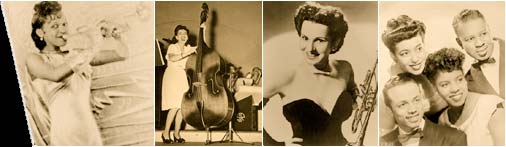
Pictures of the women, bands and film and television footage of
the women and their performances will bring these stories to life.
It will be punctuated with the rare and incredible music created
by these women.
LADY BE GOOD is divided into segments
which focus on particular issues; All In The Family,
Show Business and Dancehalls and Riverboats
(covers womens musical opportunities in the 1920s),
Gotta Have A Gimmick, Cut The Stuff, Swingin
and Image (covers stories of sexual and racial prejudice
and overcoming vast and constant obstacles at different stages of
careers), USO (includes the increase of all women bands
during WWII) Post War and Sell It (regards
womens roles and changes in the music business from small group
combos to television in the late 1940s and early 1950s)
and Call Me A Musician (details exhilarating stories
of performances and the opportunities these women created for girls
and women in the decades to follow).
|